ISO Certification in India 2026: Complete Registration Guide
An ISO certification tells your customers, partners, and government tenders that your business follows an internationally recognized standard for quality, safety, or management. Whether you’re a startup, an MSME, or an established company, learning how to apply for ISO certification in India correctly can open doors to bigger contracts, better credibility, and even government subsidies. This complete guide walks you through the entire process step by step.
What is ISO Certification?
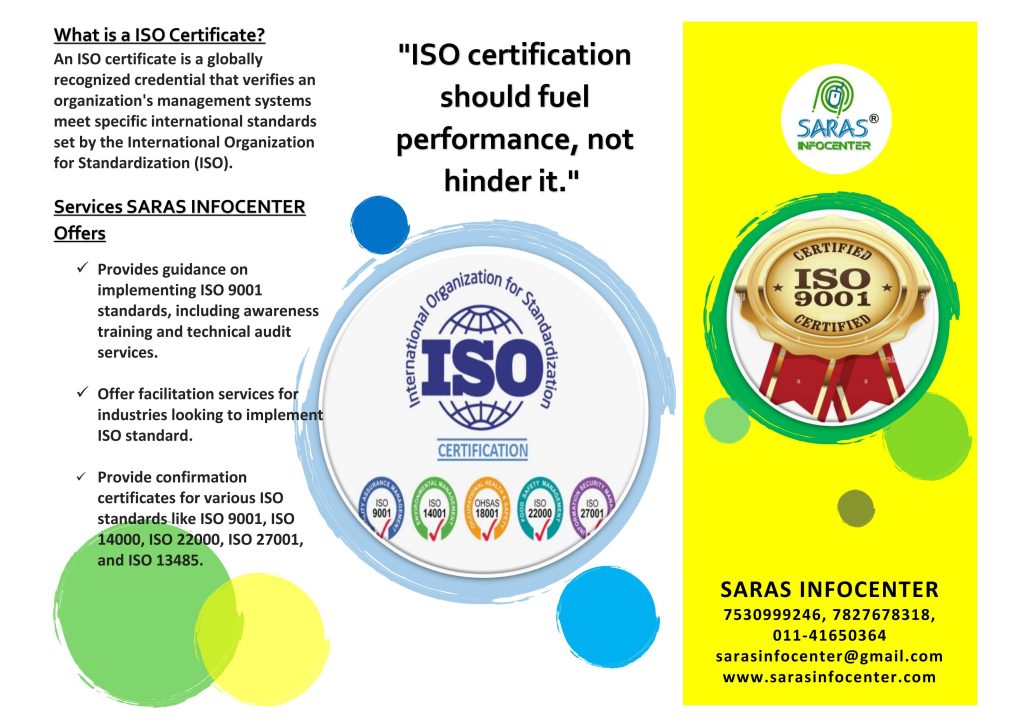
ISO (International Organization for Standardization) certification confirms that your company’s processes, products, or services meet a specific international standard. Unlike MSME/Udyam registration, ISO certification is not issued by the government directly — it is issued by accredited third-party certification bodies after they audit your business against the chosen standard.
Key Features of ISO certification in India:
- Globally recognized – accepted across countries and industries
- Issued by accredited certification bodies – not a single government department
- Standard-specific – different ISO numbers cover different areas (quality, safety, environment, security)
- Valid for 3 years – with annual surveillance audits
- Subsidy available – MSMEs can claim reimbursement on certification costs
Common ISO Standards for Indian Businesses
| ISO Standard | Covers | Best For |
| ISO 9001 | Quality Management System | Any business wanting recognized quality processes |
| ISO 14001 | Environmental Management | Manufacturing, industrial units |
| ISO 22000 | Food Safety Management | Food processing, restaurants, exporters |
| ISO 27001 | Information Security Management | IT, software, data-handling companies |
| ISO 45001 | Occupational Health & Safety | Factories, construction, high-risk workplaces |
Tip: Most first-time applicants start with ISO 9001 since it applies to almost any industry and is widely asked for in government and private tenders.
Benefits of ISO Certification
📈 Business Growth
- Eligibility for larger government and private tenders
- Stronger credibility with clients, banks, and investors
- Easier entry into export markets that require ISO compliance
⚙️ Operational Benefits
- Standardized, documented processes reduce errors
- Better internal accountability and quality control
- Improved customer satisfaction and fewer complaints
💰 Financial Benefits for MSMEs
- Registered MSMEs can get up to 50% reimbursement on ISO certification expenses under government MSME schemes
- Preference in government procurement and tenders
Eligibility for ISO Certification
There’s no fixed eligibility criteria based on turnover or business size — any business type can apply, including:
- Proprietorship firms
- Partnership firms and LLPs
- Private and Public Limited Companies
- MSMEs and startups
- NGOs, trusts, and societies (for applicable standards)
Documents Required for ISO Certification in India
| Document | Purpose |
| Business registration proof | Proprietorship/Partnership/Incorporation certificate |
| PAN Card | Business identity verification |
| GST Certificate | If applicable to your business |
| Address proof | Registered office/business premises |
| MSME/Udyam certificate | Required to claim the subsidy on certification cost |
| Process documentation | Quality manual, SOPs relevant to the chosen ISO standard |
| Invoices/business proof | Evidence the business is operational |
Step-by-Step: How to Apply for ISO Certification
1: Choose the Right ISO Standard
- Identify which standard matches your industry and goals (e.g., ISO 9001 for general quality, ISO 27001 for data security)
2: Select an Accredited Certification Body
- Choose a certification body accredited by a recognized accreditation board (in India, look for NABCB accreditation or IAF-member accreditation for international acceptance)
- Warning: Verify accreditation before paying — unaccredited “ISO certificates” are not recognized in tenders or exports
3: Submit Application & Documents
- Fill the certification body’s application form with business details
- Submit the required documents listed above
4: Implement the Management System
- Set up documented processes, quality manuals, and SOPs matching the standard’s requirements
- Train staff on the new processes
5: Stage 1 Audit (Documentation Review)
- The certification body reviews your documented system for gaps before the actual site audit
6: Stage 2 Audit (Certification Audit)
- Auditors visit your premises (or conduct a remote audit) to verify the system is actually implemented and followed
- Any non-conformities found must be corrected before certification is granted
7: Certificate Issuance
- Once you pass the audit, the certification body issues your ISO Certificate, valid for 3 years
8: Annual Surveillance Audits
- Certification bodies conduct surveillance audits each year to confirm ongoing compliance
- A recertification audit is done before the 3-year certificate expires
Complete Application Checklist
Before starting, ensure you have:
✓ Chosen the correct ISO standard for your business
✓ Business registration and PAN documents ready
✓ GST certificate (if applicable)
✓ MSME/Udyam certificate (to claim subsidy)
✓ Documented processes/SOPs for the chosen standard
✓ Verified accreditation of the certification body
ISO Certification Cost & Subsidy
| Component | Details |
| Certification Fee | Varies by certification body, business size, and standard chosen — there is no single fixed government fee |
| MSME Subsidy | Up to 50% reimbursement of certification cost for registered MSMEs under government schemes |
| Annual Surveillance | Recurring cost each year to maintain certification validity |
Important: Since certification bodies set their own fees, always get quotes from 2–3 accredited bodies before choosing one.
Processing Time
- Documentation & system setup: 2–4 weeks depending on business readiness
- Stage 1 + Stage 2 audits: Typically completed within a few weeks of application
- Total time: Most small businesses complete the process in 4–8 weeks
Common Mistakes to Avoid
| Mistake | Solution |
| Choosing an unaccredited certification body | Always verify NABCB/IAF-member accreditation first |
| Picking the wrong ISO standard | Match the standard to your actual business activity and goals |
| Treating it as a “paperwork-only” exercise | Actually implement the documented processes — auditors check real practice |
| Not claiming the MSME subsidy | Register on Udyam first, then apply for reimbursement |
| Ignoring surveillance audits | Missing annual audits can lead to certificate suspension |
FAQs About ISO Certification
Q1: Is ISO certification mandatory in India?
Answer: No, it’s voluntary in most industries, but many tenders, clients, and export markets require it as a condition of doing business.
Q2: Which ISO certificate should a small business get first?
Answer: Most small businesses start with ISO 9001 (Quality Management), since it’s the most widely recognized and applicable across industries.
Q3: How long is an ISO certificate valid?
Answer: ISO certificates are valid for 3 years, with annual surveillance audits required to maintain validity.
Q4: Can MSMEs get a subsidy for ISO certification?
Answer: Yes, registered MSMEs can claim up to 50% reimbursement of certification costs under government MSME schemes.
Q5: How do I check if a certification body is genuine?
Answer: Verify that the certification body is accredited by NABCB or another IAF-member accreditation board — this ensures your certificate is internationally recognized.
Q6: Can a business get more than one ISO certification?
Answer: Yes, businesses commonly hold multiple certifications (e.g., ISO 9001 and ISO 27001 together) depending on their needs.
Final Thoughts
Learning how to apply for ISO certification the right way — choosing the correct standard, working with an accredited body, and genuinely implementing the required processes — turns a compliance exercise into a real business advantage. Combined with the MSME subsidy, it’s one of the most cost-effective ways to boost your company’s credibility and tender eligibility.
Need help choosing the right ISO standard or handling the paperwork? Saras Infocenter can guide you through the entire application process end-to-end.