
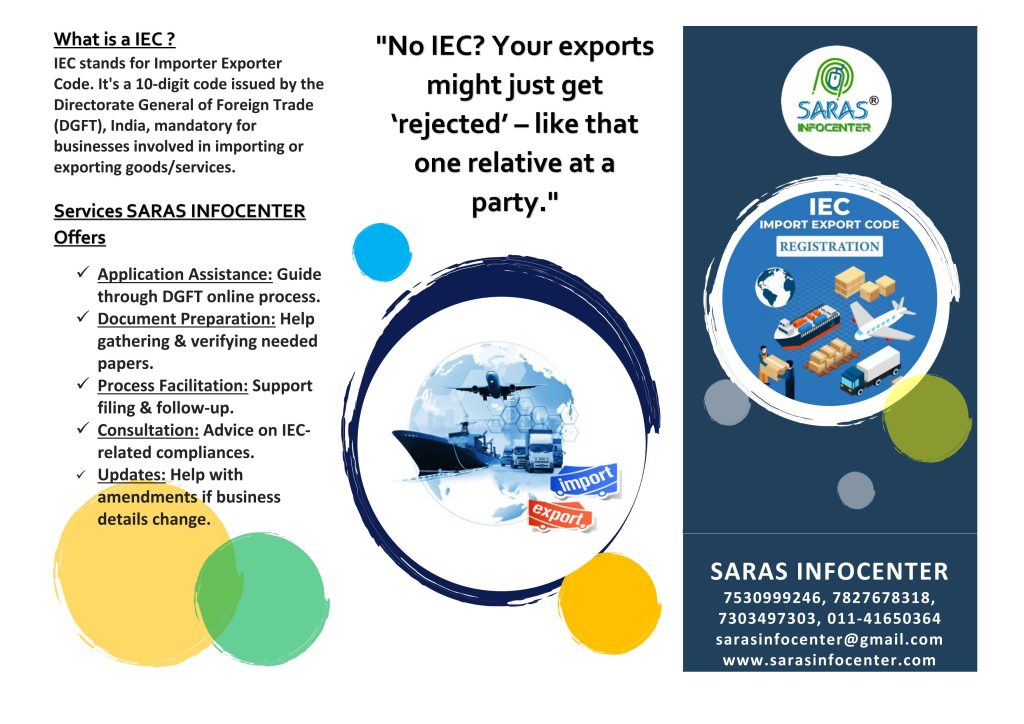
If you’re planning to import raw materials, export finished goods, or simply take your business global, there’s one registration you cannot skip: the Import Export Code (IEC). Without it, your goods don’t move past customs, and your bank won’t process international payments — regardless of how ready your business is to trade. Here’s everything you need to know about IEC registration in 2026, explained simply.

What Is an Import Export Code (IEC)?
The Import Export Code is a 10-digit business identification number issued by the Directorate General of Foreign Trade (DGFT), which operates under India’s Ministry of Commerce and Industry. Think of it as your business’s passport for international trade — without it, no legal import or export of goods and services can take place from India.
Since IEC numbers are now PAN-based, the code follows your business PAN’s format. However, you still need to apply separately through the DGFT portal and receive a distinct IEC certificate — simply having a PAN doesn’t automatically grant you one.
Who Needs an IEC?
Almost any business engaged in cross-border trade requires an IEC, including:
- Proprietorships
- Partnership firms
- Limited Liability Partnerships (LLPs)
- Private and public limited companies
- Trusts, Societies, and HUFs (Hindu Undivided Families) engaged in trade
Since IEC is PAN-based, only one IEC is issued per PAN — so if your business has multiple product lines or branch offices, you use the same IEC across all of them instead of applying separately for each.
Note: If you’re only exporting services (like software or consulting) and not claiming any Foreign Trade Policy benefits, you typically don’t need an IEC. It becomes necessary once you want to access DGFT export schemes or incentives.
Why IEC Registration Matters
1. Mandatory for Customs Clearance
No shipment — import or export — can clear Indian customs without a valid IEC. Even if your product is ready and your buyer has paid, your goods will sit at the port until this number is on file.
2. Required for International Banking
Banks will not process inward remittances against your export proceeds, or outward remittances for imports, without your IEC. This directly affects your cash flow and your ability to get paid on time.
3. Unlocks Government Schemes and Incentives
With a valid IEC, businesses become eligible for various DGFT and government export promotion schemes, incentives, and benefits — support that’s simply inaccessible without this registration.
4. Lifetime Validity, One-Time Process
Unlike several other business registrations, IEC has lifetime validity. Once issued, there’s no renewal hassle — though you are required to complete an annual update on the DGFT portal (typically between April and June) to keep your IEC active.
5. Builds Credibility with International Partners
Global buyers and suppliers often check for a valid IEC before entering into trade agreements. It signals that your business is recognized and compliant with India’s foreign trade regulations.

Documents Required for IEC Registration
Keep the following ready before applying:
- PAN card of the business/individual
- Aadhaar card of the proprietor, partner, or director (linked mobile number required for OTP verification)
- Address proof of the business (utility bill, rent agreement, or property documents)
- Bank proof — a cancelled cheque or bank certificate confirming the current/savings account in the business’s name
- Active email ID and mobile number for DGFT portal registration
- Certificate of incorporation or partnership deed, depending on business structure
If your business already has a GSTIN, several fields on the IEC application are auto-populated using your GST data, which speeds things up considerably.
Step-by-Step IEC Registration Process
- Register on the DGFT portal (dgft.gov.in) using a valid email address and mobile number to create your login credentials.
- Log in and select “Apply for IEC” under the services section, which opens Form ANF-1A (Aayaat Niryaat Form).
- Fill in business details — name, address, PAN, business type, and bank account information.
- Upload the required documents in the specified format and size.
- Pay the applicable government fee (currently a nominal amount) and e-sign the application using an Aadhaar-based OTP or digital signature.
- Submit the application for DGFT review.
- Receive your IEC — typically within 2 to 7 working days if all documents and details are accurate. You can then view and download it instantly from the DGFT portal.
Common Mistakes That Delay IEC Approval
- Mismatched details: Business name, address, or PAN details that don’t exactly match across documents are a leading cause of rejection.
- Incorrect bank proof: An outdated cancelled cheque or a bank certificate not matching the applicant’s name can stall processing.
- Unlinked Aadhaar and mobile number: Since verification relies on Aadhaar-based OTP, an outdated mobile number linked to Aadhaar can cause delays.
- Skipping the annual update: Forgetting the mandatory annual update (April–June) can result in your IEC being deactivated, disrupting ongoing trade.
- Applying for multiple IECs on the same PAN: Since IEC is PAN-based, attempting to register more than one per PAN will be rejected.

How Saras Infocenter Can Help
Even though the IEC application process is fully online, small errors in documentation or business details can cost you days — sometimes weeks — of delay, along with lost orders and shaken buyer confidence. At Saras Infocenter, we take that risk off your plate.
Our team assists businesses with:
- Document verification and preparation before submission
- Accurate filing of Form ANF-1A on the DGFT portal
- Guidance on structuring your application based on your business type
- Timely reminders and support for your mandatory annual IEC update
- End-to-end support for related registrations like GST and ICEGATE
We believe in transparent pricing, honest timelines, and no last-minute surprises — just clear, professional guidance so your international trade plans don’t get stuck in paperwork.
Frequently Asked Questions
Is IEC registration mandatory for all import/export businesses?
Yes, no import or export of goods can legally take place from India without a valid IEC, unless specifically exempted by DGFT.
How long does it take to get an IEC?
Typically 2 to 7 working days, provided your documents and application details are accurate and complete.
Does IEC need to be renewed?
No, IEC has lifetime validity. However, you must complete a mandatory annual update on the DGFT portal (April–June) to keep it active.
Can one business have multiple IEC numbers?
No. Since 2021, IEC is PAN-based, and only one IEC is issued per PAN, regardless of how many business lines or branches you operate.
Do service exporters need an IEC?
Generally not, unless you’re claiming benefits under India’s Foreign Trade Policy or dealing with DGFT-specified services.
Final Thoughts
An Import Export Code isn’t just another government formality — it’s the foundation that makes international trade legally possible for your business. Whether you’re a first-time exporter or scaling an existing import operation, getting your IEC right the first time saves you from costly delays down the line.
Ready to get your IEC without the hassle of navigating the DGFT portal alone? Get in touch with Saras Infocenter today for a free consultation, and let our team handle the paperwork while you focus on growing your business globally.