
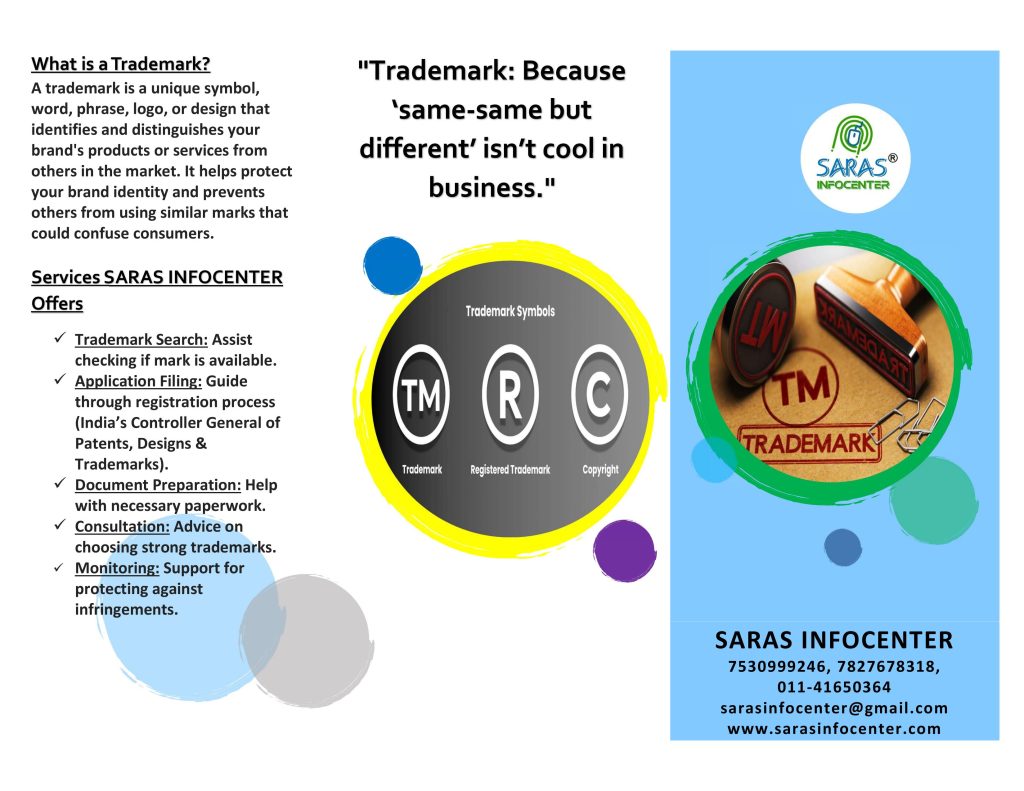
In today’s business world, protecting your intellectual property is crucial. But many people confuse trademark and copyright, using these terms interchangeably when they’re actually very different. Understanding the difference between trademark and copyright and knowing how to apply for each can save you from legal troubles and protect your valuable assets.
Whether you’re a business owner, artist, writer, or creator, this guide will walk you through everything you need to know about trademarks and copyrights in India, along with step-by-step application processes.
Quick Answer: What’s the Main Difference?
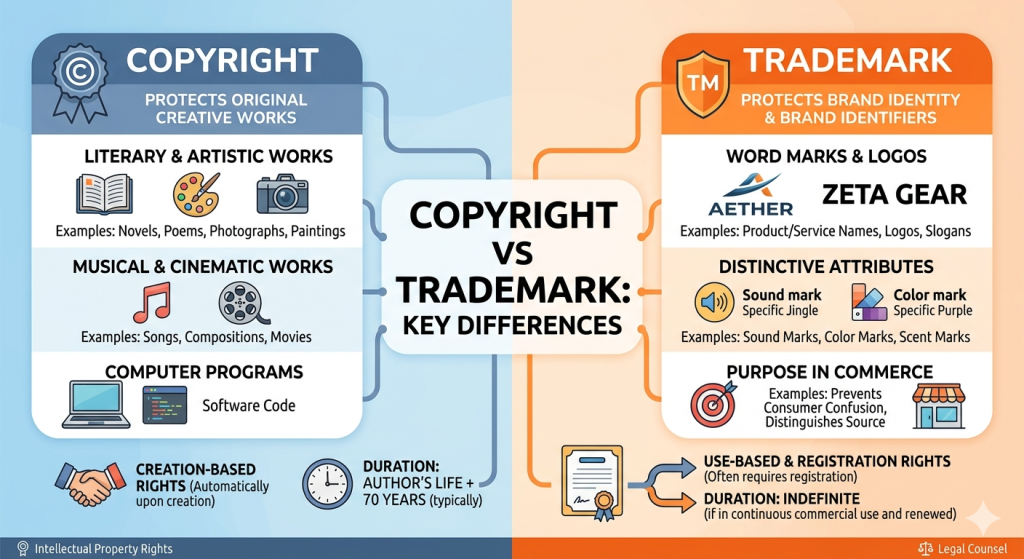
The fundamental difference is simple:
- Trademark protects brand identifiers like logos, names, slogans, and symbols that distinguish your business
- Copyright protects original creative works like books, music, art, films, and software
Let’s dive deeper into understanding each type of protection.
What is a Trademark?
A trademark is a distinctive sign that identifies and distinguishes your goods or services from those of others in the marketplace. It can be:
- Brand names (e.g., “Nike”, “Apple”)
- Logos and symbols (e.g., Apple’s apple logo)
- Slogans (e.g., “Just Do It”)
- Colors or designs
- Product packaging
- Sound marks (e.g., Nokia’s tune)
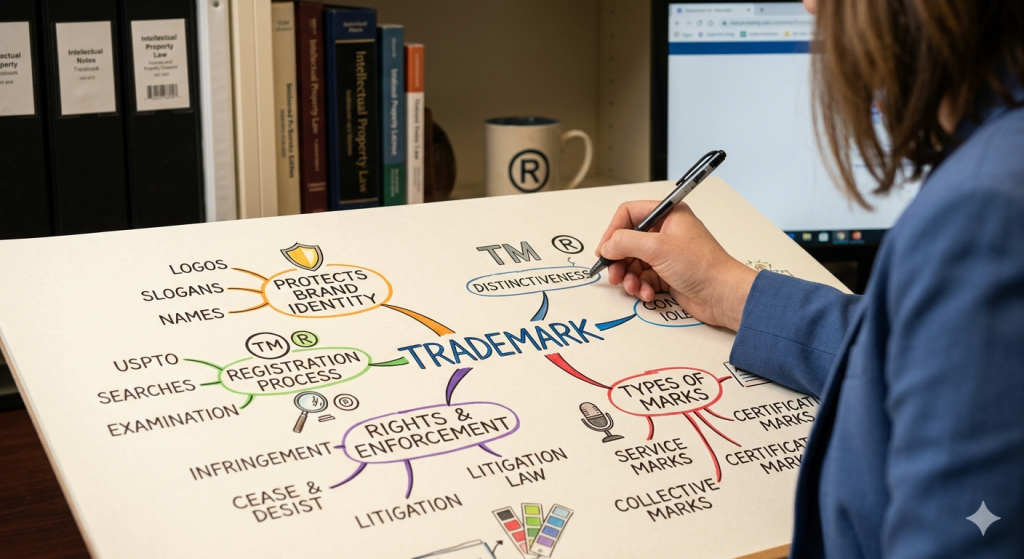
Purpose of Trademark
Trademarks help consumers identify the source of products or services and build brand reputation. They prevent others from using similar marks that could confuse customers.
Duration of Trademark Protection
- Initial period: 10 years from registration date.
- Renewable: Indefinitely, every 10 years.
- Total protection: Can last forever if renewed regularly.
What is Copyright?
Copyright protects original works of authorship that are fixed in a tangible medium. It grants creators exclusive rights to:
- Reproduce the work
- Distribute copies
- Perform or display the work publicly
- Create derivative works
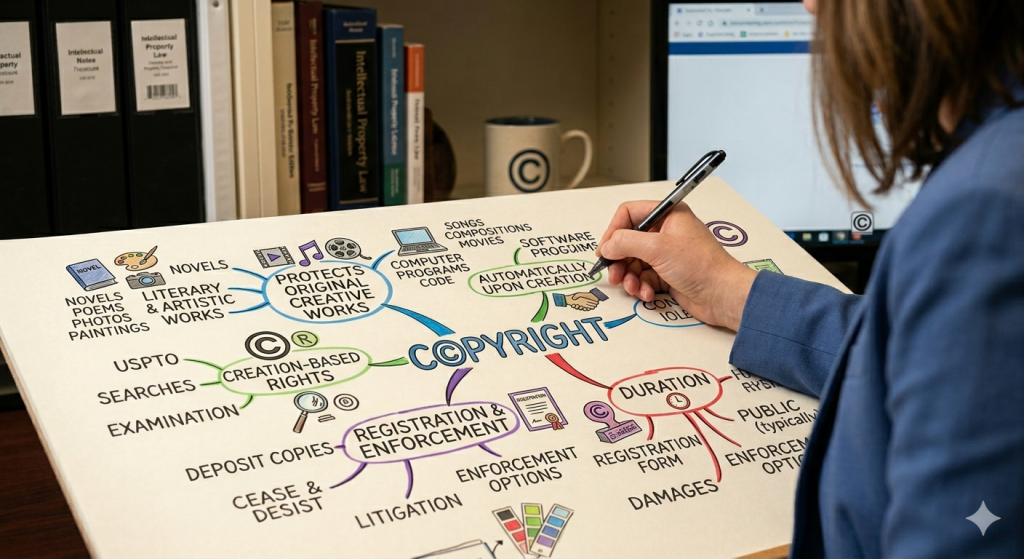
What Does Copyright Protect?
| Category | Examples |
| Literary works | Books, articles, poems, scripts, computer code |
| Musical works | Songs, compositions, lyrics |
| Artistic works | Paintings, drawings, photographs, sculptures |
| Dramatic works | Plays, screenplays, movies |
| Cinematographic films | Movies, videos, documentaries |
| Sound recordings | Audio recordings, podcasts |
| Software | Computer programs, apps |
Important Note
Copyright protects the expression of ideas, not the ideas themselves. For example, copyright protects your specific book, not the concept of writing a book.
Duration of Copyright Protection
- Literary, dramatic, musical, and artistic works: Life of the author + 60 years
- Cinematographic films, sound recordings, photographs: 60 years from publication date.
Key Differences Between Trademark and Copyright
Here’s a comprehensive comparison to help you understand the distinctions:
| Aspect | Trademark | Copyright |
| Purpose | Identifies and distinguishes goods/services | Protects original creative works |
| What’s Protected | Brand names, logos, symbols, slogans | Books, music, art, films, software |
| Registration Required | Yes, for legal protection | Automatic upon creation (registration optional) |
| Duration | 10 years, renewable indefinitely | Life + 60 years (non-renewable) |
| Scope | Specific goods or services only | Original expressions of ideas |
| Managing Authority | Trade Marks Registry (India) | Copyright Office (India) |
| Infringement | Using similar marks causing confusion | Unauthorized reproduction/distribution |
| Fees | ₹9,000-₹45,000 per class | ₹500-₹5,000 |
| Processing Time | 12-18 months | 2-3 months |
When Do You Need a Trademark?
You should apply for trademark registration if:
- You own a business name or brand
- You have a logo representing your company
- You use a slogan for marketing
- You sell products under a specific brand name
- You offer services with a distinctive name
- You want nationwide protection for your brand
- You plan to expand your business nationally
Example: If you start a clothing brand called “Delhi Threads” with a unique logo, you need trademark protection to prevent others from using the same name or logo.
When Do You Need Copyright?
Copyright protection is essential when:
- You write books, articles, or blogs
- You create music, songs, or compositions
- You produce art, paintings, or photographs
- You make movies, videos, or films
- You develop software or apps
- You create podcasts or audio recordings
- You design educational content
Important: In India, copyright protection is automatic once you create an original work. However, registration provides legal evidence and makes enforcement easier.
Example: If you write a novel or compose a song, copyright automatically protects it. But registering it strengthens your legal position if someone copies your work.
How to Apply for Trademark in India: Step-by-Step Guide
Step 1: Conduct Trademark Search
Before applying, search the India Trademark Database to ensure your mark isn’t already registered.
- Visit: ipindia.gov.in
- Use the “Public Search” feature
- Check for similar marks in your category
Step 2: Determine Your Trademark Class
Trademarks are classified into 45 classes (34 for goods, 11 for services). Choose the class that matches your product or service.
Common classes:
- Class 25: Clothing, footwear
- Class 9: Electronics, software
- Class 35: Advertising, business services
- Class 41: Education, training services
Step 3: Prepare Required Documents
You’ll need:
| Document | Details |
| Trademark Application Form | Form TM-A |
| Trademark Logo/Name | Clear image of logo or text |
| Applicant Details | Name, address, nationality |
| Class Description | Goods/services category |
| Priority Document | If claiming priority from foreign registration |
| Power of Attorney | If applying through trademark attorney |
| MSME/Udyam Certificate | For fee concession (₹4,500 instead of ₹9,000) |
Step 4: File Your Application
Online Application (Recommended):
- Visit ipindia.gov.in
- Login or create account
- Fill Form TM-A
- Upload trademark image
- Pay fees online (₹9,000 for individuals, ₹4,500 for MSME)
- Submit application
Offline Application:
- Submit physical form at Trademark Registry office
- Pay fees via bank challan
Step 5: Application Examination
- Registry examines application within 1-3 months
- Examiner may issue objections (office action)
- Respond to objections within 30 days
Step 6: Trademark Publication
- If accepted, trademark published in Trade Marks Journal
- Open for 4 months for public opposition
Step 7: Registration
- If no opposition filed, trademark registered
- You receive registration certificate
- Trademark protected for 10 years
Total Processing Time: 12-18 months.
How to Apply for Copyright in India: Step-by-Step Guide
Step 1: Ensure Your Work is Original
- Work must be original creation
- Fixed in tangible medium (paper, digital file, etc.)
- Not copied from someone else
Step 2: Prepare Required Documents
You’ll need:
| Document | Details |
| Copyright Application Form | Form XIV |
| Copy of Work | Book manuscript, music file, software code, etc. |
| Applicant Details | Name, address, contact information |
| Author Details | Name, nationality (if different from applicant) |
| Publication Details | Date and place (if published) |
| No Objection Certificate | If applying through agent |
| Payment Receipt | Fee payment proof |
Step 3: File Your Application
Online Application (Recommended):
- Visit copyright.gov.in
- Register and login
- Fill Form XIV
- Upload copy of work
- Pay fee online (₹500-₹5,000 depending on work type)
- Submit application
Offline Application:
- Submit physical form at Copyright Office (New Delhi)
- Pay fees via bank challan
Step 4: Application Examination
- Examiner reviews application within 30 days
- May request corrections if needed
- Respond to queries promptly
Step 5: Registration Certificate
- Upon approval, receive copyright registration certificate
- Certificate includes registration number and date
- Valid for entire duration (life + 60 years)
Total Processing Time: 2-3 months
Cost Comparison: Trademark vs Copyright
Trademark Fees (India)
| Applicant Type | Fee per Class |
| Individual/MSME | ₹4,500 |
| Small Enterprise | ₹9,000 |
| Other Companies | ₹9,000-₹45,000 |
Copyright Fees (India)
| Work Type | Fee |
| Literary/Dramatic | ₹500 |
| Musical | ₹500 |
| Artistic | ₹500 |
| Cinematographic | ₹5,000 |
| Sound Recording | ₹5,000 |
Common Mistakes to Avoid
Trademark Mistakes
- ❌ Not searching for existing trademarks
- ❌ Choosing similar marks to existing brands
- ❌ Selecting wrong class
- ❌ Failing to respond to examiner objections
- ❌ Not renewing every 10 years
Copyright Mistakes
- ❌ Assuming registration is mandatory (it’s not)
- ❌ Copying work from others
- ❌ Not keeping creation records
- ❌ Delaying registration when possible
- ❌ Not updating copyright information
Which One Should You Choose?
| Your Situation | Choose |
| Starting a business with brand name/logo | Trademark |
| Writing a book or creating art | Copyright |
| Developing software or app | Both (trademark for brand, copyright for code) |
| Making music or songs | Copyright |
| Creating movie or video | Copyright |
| Selling products under brand name | Trademark |
| Teaching with original content | Copyright |
Best Practice: Many businesses need both. For example, a software company needs trademark for its brand name/logo and copyright for its software code.
Protection Without Registration
| Type | Protection Without Registration | With Registration |
| Trademark | Very limited (only local use) | Strong nationwide protection |
| Copyright | Automatic protection | Legal evidence + easier enforcement |
Key Point: Trademark registration is mandatory for strong protection. Copyright is automatic but registration strengthens your legal position.
Enforcement and Legal Action
Trademark Infringement
If someone uses your trademark:
- Send cease and desist letter
- File infringement lawsuit in court
- Seek damages and injunction
- Report to customs for counterfeit goods
Copyright Infringement
If someone copies your work:
- Send legal notice
- File civil lawsuit for damages
- Seek criminal remedies (if serious)
- Report to police for piracy
Registration makes enforcement significantly easier in both cases.
Quick Checklist Before Applying
For Trademark
✓ Conduct thorough trademark search
✓ Choose correct class
✓ Prepare clear logo/image
✓ Have applicant documents ready
✓ Budget for fees (₹4,500-₹9,000)
✓ Plan for 12-18 month processing
For Copyright
✓ Ensure work is original
✓ Keep creation records
✓ Save copies in tangible medium
✓ Prepare application form
✓ Budget for fees (₹500-₹5,000)
✓ Plan for 2-3 month processing
Final Thoughts
Understanding the difference between trademark and copyright is essential for protecting your intellectual property in India. While trademarks protect your brand identity, copyrights protect your creative works.
Remember:
- Apply for trademark if you have a business name, logo, or brand
- Copyright automatically protects creative works, but registration helps enforcement
- Both require different application processes and authorities
- Processing times vary significantly (12-18 months for trademark, 2-3 months for copyright)
- Costs differ substantially (₹4,500-₹45,000 for trademark, ₹500-₹5,000 for copyright)
Start protecting your intellectual property today. Whether you’re launching a business or creating original content, proper IP protection ensures your hard work remains secure and gives you legal recourse against infringement.
Protect your brand, protect your creativity—your intellectual property matters.